
GB/T 17447-2012 Aerosol Valve — National Standard Interpretation Report
1. Basic Information
Item | Content |
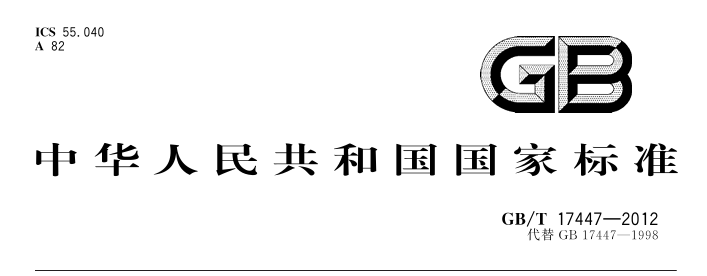
Standard No. | GB/T 17447—2012 |
English Title | Aerosol Valve |
Supersedes | GB 17447—1998 |
Issued Date | 2012-12-31 |
Effective Date | 2013-07-01 |
ICS No. | 55.040, A82 |
Technical Committee | National Packaging Standardization Technical Committee (SAC/TC49) |
Issuing Authority | General Administration of Quality Supervision, Inspection and Quarantine of the PRC & Standardization Administration of the PRC |
Main Drafting Organizations: Zhongshan Meijieshi Packaging Products Co., Ltd.; Suzhou Boxin Precision Packaging Co., Ltd.; Guangzhou Baocili Chemical Co., Ltd.; Zhongshan Lianchang Spray Pump Co., Ltd.; Zhongshan Yingbo Aerosol Valve Co., Ltd.; Yalian Chuangzhan Packaging (Guangzhou) Co., Ltd.; Yanshan Jinxing Aerosol Valve Manufacturing Co., Ltd.; Zhejiang Green Island Technology Co., Ltd.; Aerosol Committee of China Packaging Federation
Main Drafters: Liang Peihui, Deng Weiqiu, Wang Yongping, Lin Tianda, Yang Jinxing, Liu Zhiming, Yang Jinwen, Shi Yongzhong, Zhang Yaoping, Wang Xiaobing, Zhao Kun
2. Scope
This standard specifies the requirements, test methods, inspection rules, marking, packaging, transportation and storage for aerosol valves.
This standard applies to aerosol valves with matching diameters of φ25.4mm and φ20mm for aerosol can openings.
3. Terminology and Definitions
This standard defines 24 terms covering valve types, structural components, and functional elements.
Clause | Term | Definition |
3.1 | Aerosol Valve | A mechanical device fixed on an aerosol container that, when closed, ensures the contents do not leak, and when actuated, releases the contents in a predetermined form |
3.2 | Non-metering Aerosol Valve | An aerosol valve that discharges contents continuously when actuated until closed |
3.3 | Metering Aerosol Valve | An aerosol valve that discharges a metered quantity of contents with each actuation |
3.4 | Aerosol Valve for Upright Use | An aerosol valve designed for upright use of the aerosol product |
3.5 | Aerosol Valve for Inverted Use | An aerosol valve designed for inverted use of the aerosol product |
3.6 | Aerosol Valve for Upside-down Use | An aerosol valve that can be used in both upright and inverted orientations |
3.7 | Aerosol Valve for 360° Orientation Use | An aerosol valve that can be used in any orientation |
3.8 | Pressing Aerosol Valve | An aerosol valve actuated by pressing vertically, with contents discharged through the passage |
3.9 | Toggle Aerosol Valve | An aerosol valve actuated by side-tilting, with contents discharged through the passage |
3.10 | Male Aerosol Valve | An aerosol valve where the stem protrudes above the mounting cup surface and the actuator fits over the stem |
3.11 | Female Aerosol Valve | An aerosol valve where the actuator and stem are integrated and inserted into the stem seat bore below the mounting cup surface |
3.12 | Bag-on-Valve (BOV) | An aerosol valve that separates the product contents and propellant through a bag attached to the valve |
3.13 | Aerosol Valve with Steel Mounting Cup | An aerosol valve whose mounting cup base material is tinplate or other coated steel sheet or stainless steel |
3.14 | Aerosol Valve with Aluminium Mounting Cup | An aerosol valve whose mounting cup base material is aluminium alloy sheet |
3.15 | Valve Stem | The component on the aerosol valve that connects to the actuator and allows the aerosol contents to be discharged through its passage |
3.16 | Outer Gasket (Cup Gasket) | A static sealing element between the mounting cup curl and the aerosol container |
3.17 | Mounting Cup | A metal component on the aerosol valve used for fastening and sealing with the aerosol can |
3.18 | Inner Gasket (Stem Gasket) | A dynamic sealing element installed between the mounting cup and the valve housing |
3.19 | Spring | An elastic component that supports the valve stem and inner gasket and enables their return |
3.20 | Valve Housing | An outer shell component that supports other valve elements and is mounted inside the mounting cup |
3.21 | Metering Valve Housing | A component in a metering aerosol valve mounted inside the mounting cup that supports other valve elements and determines the metering value |
3.22 | Dip Tube | A plastic tube connected to the valve housing that conveys the aerosol contents |
3.23 | Valve Seat | A component in a female aerosol valve that supports the actuator stem |
3.24 | Bag | A component in a Bag-on-Valve (BOV) system used to contain the aerosol product contents |
4. Specifications and Classification
4.1 Specifications
Two specifications based on the matching diameter with the aerosol can opening:
φ25.4mm — General standard specification
φ20mm — Small specification
4.2 Classification
Classification Basis | Categories |
By Spray Volume | Non-metering, Metering |
By Orientation | Upright, Inverted, Upside-down, 360° Orientation |
By Structure | Male, Female |
By Actuation | Pressing, Toggle |
By Mounting Cup Material | Steel, Aluminium |
4.3 Structural Components of Aerosol Valve
An aerosol valve consists of seven core components:
Valve Stem — Connects to the actuator; provides passage for contents
Outer Gasket (Cup Gasket) — Static seal between mounting cup and container
Mounting Cup — Metal component for fastening and sealing with the aerosol can
Inner Gasket (Stem Gasket) — Dynamic seal between mounting cup and valve housing
Spring — Supports the stem and inner gasket and enables return
Valve Housing — Housing that supports other components
Dip Tube — Delivers contents to the valve system
5. Technical Requirements
5.1 Appearance
The valve shall be complete, clean, and intact, with no scratches or peeling on protective coatings
All parts shall be correctly positioned
5.2 Dimensional Requirements
φ25.4mm Aerosol Valve Matching Dimensions (Table 1):
Item | Specifications (mm) |
Mounting Cup Material Thickness S | 0.27, 0.28, 0.30, 0.40, 0.42, 0.50, 0.60 |
Mounting Cup Outer Curl Diameter D ±0.15 | 32.50, 32.50, 32.50, 32.50, 32.50, 32.90, 33.10 |
Mounting Cup Total Height H | ≥8.0 |
Mounting Cup Curl Height H₁ | 3.30⁺⁰·³⁰₋₀·₂₅ |
Mounting Cup Inner Diameter d | φ25.15±0.08 |
φ20mm Aerosol Valve Matching Dimensions (Table 2):
Item | Specification (mm) |
Mounting Cup Curl Height H₁ | 5.60 ≤ H₁ ≤ 8.85 |
Mounting Cup Inner Diameter d | φ20⁺⁰·⁴⁵₋₀·₁₅ |
Dimensional Tolerances:
Item | Tolerance |
Stem Height H₂ | ±0.30 mm |
Stem Top Diameter d₁ | 0 ~ +0.10 mm |
Dip Tube Length L ≤ 150mm | ±1.5 mm |
150 ≤ L ≤ 220mm | ±2.0 mm |
L ≥ 220mm | ±3.0 mm |
5.3 Performance Requirements
Clause | Item | Performance Requirement |
5.3.1 | Flow Performance | All passages shall be clear when actuated |
5.3.2 | Seal Integrity | No leakage under ≥0.85MPa for 1min |
5.3.3 | Mounting Cup Pressure Resistance | 1.8MPa hold 1min, Δh ≤ 0.30mm |
5.3.4 | Dip Tube Pull-out Force | Non-metering: ≥30N; Metering: ≥15N |
5.3.5 | Metering Accuracy | ≤100μL, tolerance ±15% |
5.3.6 | Valve Housing Push-out Force | ≥180N |
5.3.7 | Bag Seal Integrity | No leakage under ≥400N for ≥1min |
5.4 Hygiene Requirements
Aerosol valves used for contact with food or pharmaceuticals shall comply with relevant national regulations.
5.5 Compatibility Requirements
Different product formulations require different gasket materials. Manufacturers shall provide samples for compatibility testing and obtain user confirmation.
6. Test Methods
6.1 Appearance Inspection
Visual inspection under natural light or 40W lamp at a distance of 20cm.
6.2 Dimensional Measurement
Item | Instrument | Accuracy |
Diameter and Height | Vernier Caliper | 0.01 mm |
Dip Tube Length | Steel Ruler or Special Gauge | 0.5 mm |
Stem Height | General or Special Gauge | 0.02 mm |
Stem Diameter | General Measuring Tool | 0.02 mm |
6.3 Performance Tests
Item | Test Conditions | Acceptance Criteria |
Flow Performance | Pressurize to 0.5MPa, press actuator | Continuous bubbles |
Seal Integrity | Pressurize to ≥0.85MPa, hold 1min | No bubbles |
Cup Pressure Resistance | Pressurize to 1.8MPa, hold 1min | Δh ≤ 0.30mm |
Dip Tube Pull-out | 25°C±5°C, tensile speed 50mm/min | Non-metering ≥30N; Metering ≥15N |
Metering Accuracy | Per GB/T 14449-2008 clause 5.9 | ±15% |
Housing Push-out | 25°C±5°C, speed 100mm/min | ≥180N |
Bag Seal Integrity | ≥400N for ≥1min | No rupture or leakage |
Main Test Instruments: - Leak Test Apparatus: Pressure gauge 0~1.6MPa, Class 1.6 - Pressure Test Apparatus: Range 0~2.5MPa, Class 1.6 - Tensile/Compression Testing Machine: Max load 500N, accuracy ±1% - Special Dial Indicator: 0~10mm, division value 0.01mm
7. Inspection Rules
7.1 Inspection Lot
Products of the same type and specification delivered in the same batch constitute one inspection lot.
7.2 Sampling Plan
Sampling inspection shall be conducted according to the double sampling plan of GB/T 2828.1-2003.
7.3 Inspection Classification
Routine Inspection: Appearance, matching dimensions, dip tube length tolerance, flow performance, seal integrity
Type Inspection: All of Chapter 5 (except 5.5 Compatibility)
Conditions for Type Inspection: a) New product or relocation of production b) Change in structure, material, or process c) Annually during normal production d) After production halt of ≥6 months e) Significant difference from last type inspection f) Requested by national quality supervision authority g) Requested by the user
7.4 AQL Values for Inspection Items
Inspection Item | Inspection Level | Defect Class | AQL |
Appearance | S-4 | Class B | 1.5 |
Appearance | S-4 | Class C | 4.0 |
Dimensions | S-4 | Class B | 1.5 |
Flow Performance | S-2 | Class A | 0.65 |
Seal Integrity | S-2 | Class A | 0.65 |
Cup Pressure Resistance | S-2 | Class A | 0.65 |
Dip Tube Pull-out | S-2 | Class B | 1.5 |
Metering Accuracy | S-2 | Class B | 1.5 |
Housing Push-out | S-2 | Class B | 1.5 |
Bag Seal Integrity | S-2 | Class B | 1.5 |
7.5 Judgement Rule
The batch is qualified only when all inspection items pass.
8. Marking, Packaging, Transportation and Storage
8.1 Marking
Each package shall include a certificate indicating: manufacturer name, product name, specification, manufacturing date, batch number, quantity, and inspection mark.
8.2 Packaging
Outer packaging: corrugated carton; inner packaging: plastic film bag, or as per user requirements.
8.3 Transportation
Transport vehicles shall be clean and dry; protect from rain, sun exposure, moisture, contamination, and damage.
8.4 Storage
Products shall be stored in a dry, ventilated, and clean warehouse, protected from contamination, damage, and direct sunlight.
9. Key Changes from Previous Version (GB 17447-1998)
Compared to GB 17447-1998, this standard incorporates the following 13 key revisions:
No. | Change Description | Nature |
1 | Added terms for upside-down valve, Bag-on-Valve, metering valve housing, and bag | Added |
2 | Modified the outer diameter D of φ25.4mm valve mounting cup | Modified |
3 | Added stem height dimensional tolerance | Added |
4 | Added stem diameter dimensional tolerance | Added |
5 | Added dip tube length dimensional tolerance | Added |
6 | Increased seal test pressure requirement | Modified |
7 | Modified dip tube pull-out force requirement | Modified |
8 | Modified metering accuracy requirement | Modified |
9 | Added valve housing push-out force requirement | Added |
10 | Added bag seal integrity requirement | Added |
11 | Added hygiene requirements | Added |
12 | Added compatibility requirements | Added |
13 | Modified inspection rules | Modified |
Key Change Highlights:
Increased Seal Test Pressure: Raised to ≥0.85MPa, imposing higher requirements on product sealing reliability
New Dimensional Tolerances: Added tolerances for stem height, stem diameter, and dip tube length, improving product consistency and interchangeability
New Safety and Hygiene Requirements: Added hygiene requirements (food/drug contact) and compatibility requirements, expanding the standard’s scope
Bag-on-Valve (BOV) Technology Included: Added BOV-related terminology and performance requirements, reflecting industry technology trends
10. Standard Interpretation and Industry Significance
10.1 Standard Status
GB/T 17447-2012 is the current national standard for aerosol valves in China, serving as the technical basis for the design, production, inspection, and trade of aerosol valve products. This standard is a recommended national standard (GB/T), but it becomes mandatory when referenced by regulations or contracts.
10.2 Technical Summary
Dimension | Key Requirements |
Specifications | φ25.4mm and φ20mm diameters |
Core Performance | Seal ≥0.85MPa, Pressure Resistance 1.8MPa, Flow, Pull-out ≥30N/15N, Push-out ≥180N |
Safety | Hygiene compliance for food/drug contact valves |
Quality Consistency | AQL-based sampling inspection system |
10.3 Industry Application Guidance
Beyond this standard, the following practical considerations are important for valve selection:
Gasket Material Selection: Buna-N (water-based/alcohol-based), Neoprene (oil-based/solvent-based), Butyl (DME/strong solvent), etc., requiring compatibility testing based on formulation
Stem Orifice: Common sizes 0.33~0.61mm, affecting discharge rate
Dip Tube Length: Optimal when the tube bottom is positioned at the lower 1/3 of the can bottom radius after stabilization
Key Compatibility Tests: Cup material stability, swelling, hardness, high/low temperature testing
BOV Advantages: Contents do not directly contact the aerosol can, stable discharge, fewer preservatives, minimal residue
10.4 Standard Outlook
With the development of the aerosol industry—especially the widespread application of Bag-on-Valve (BOV) technology and the promotion of eco-friendly propellants—future revisions may further address: - Refinement and improvement of BOV-related technical requirements - Introduction of new environmentally friendly materials (e.g., recyclable materials) - Enhanced alignment with ISO international standards
Appendix: References
GB/T 17447-2012 Aerosol Valve
GB/T 2828.1-2003 Sampling Procedures for Inspection
GB/T 14449-2008 Test Methods for Aerosol Products
Industry reference materials on aerosol valve selection
The report was prepared on August 20, 2026, based on relevant industry information.